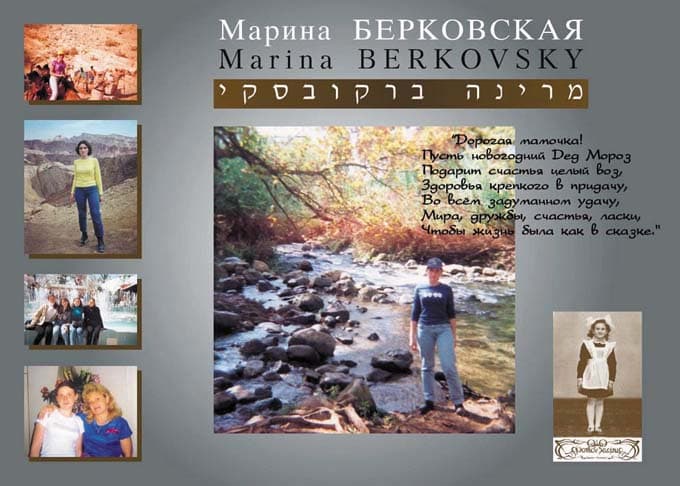

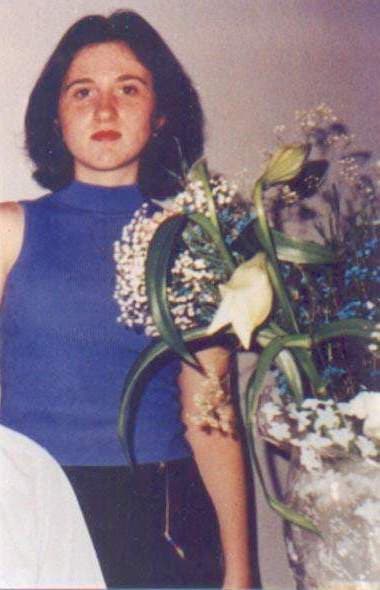
Marina Berkovsky
“Arafat is a karakurt — a spider whose bite is deadly”
Marina Berkovskaya’s family, who had repatriated from Tashkent, suffered two tragedies in four and a half years in Israel. Two and a half years ago, her father died. And now…
Marina was in the eleventh grade and planned to enter university after school. Just a week before her death, she celebrated her seventeenth birthday. Marina’s mother, Lilia Binyaminovna, brought us photographs of her daughter. In the pictures — kind, gentle faces, a serious child looking attentively into the lens, the family at the beach, the father with little Marishka, the mother carrying a birthday cake with candles. How radiantly she smiled then…
Marina’s grandmother, Alexandra Markovna Burshtein, speaks quietly:
— Marina was a very home-oriented girl. Of course, she didn’t smoke. She was completely unlike modern youth. Yes, very home-oriented. Very serious. She didn’t have a steady boyfriend, but of course she had girlfriends, friends from school. I told her: “It’s your birthday. Invite more friends, get together, dance, have some fun.” You know how young people have fun today? She answered: “You see, people are different. I don’t like everyone.”
Our photographer aimed his lens at a picture where Marina stood half-turned. Her mother stopped him:
— Don’t. Don’t take this one, she looks fuller there. She had lost weight over the last couple of months, became slimmer.
— Yes, — says the grandmother, — she’s so slim now. — And stops, having misspoken. And both women — mother and daughter — cry, holding hands. And we, grown, strong men, have nothing to comfort them with.
— That day Marina didn’t feel well. She didn’t really like dancing or noisy companies. But on Friday before her birthday, May twenty-fifth, she went to a disco with her friends. They liked it. Marina came back and said: “They told us that next time we come, we’ll get in for free. You know how things are with money now… And then, when the ‘bagrut’ exams start, I won’t go to the disco anymore.” She didn’t plan to go, but her friend Natasha said: “Let’s go. The exams are coming soon.” Marina didn’t have pockets. She put the money in her friend’s bag and didn’t take her key. She said: “Mom, you sleep, I’ll come late, you’ll open the door for me, but don’t turn on the light so you don’t wake up.” At half past twelve at night — a call. “Is Marina home?” A classmate called. “No,” I answered, “she went to the disco.” I had turned off the TV and didn’t know about the explosion. Then, around one in the morning, another boy called: “Is Marina home?” He told me about the explosion.
That is how the mother speaks. There are tears in her eyes. Outwardly she is calm, and this calmness, and the torn collar of her black clothes, and the sun outside the window create such pain that it feels as if the whole house has run out of air.
When the Arab fanatic approached the line of young people waiting at the entrance to “Dolphi,” Marina’s friend was standing far from her. The explosion threw Natasha to the ground. She did not receive serious injuries. She regained consciousness, managed to get up. She called her older brother on her mobile phone. He came, and they began searching for Marina. They called her mother… Toward morning they arrived in Abu Kabir.
— We live in Haifa, — Alexandra Markovna continues. — That evening I was talking to my daughter on the phone. She said: “Marina is going to a disco, and I’ll watch TV.” I had a bad feeling. I said: “Maybe she shouldn’t go?” and then I thought, well, let her go out before the exams. In the morning I called my daughter — no answer. I called her mobile. She says: “Marina is not here. I looked for her everywhere, in hospitals — she’s not there. There was an explosion in Tel Aviv. And maybe she…” She couldn’t say the word. And I can’t either…
Half an hour later an unfamiliar woman called us. She said: “I am from the municipal social services. A taxi has been sent for you, free of charge. It will take you to Tel Aviv.” They brought us to the morgue. We sat there for several hours. Then Lilia was called. For identification… She was whole. The doctors said she died instantly. Probably she didn’t even realize she had died. There were nails and screws in the bomb. Fragments hit her head.
For me, the main thing is to record every word. To remember this woman with a kind, bewildered face, with exhausted eyes. Someday, when we all learn to speak with golden words, we will address the Palestinians with a sermon of peace, and these words will reach every heart. But for now, I listen to Alexandra Markovna and promise myself not to change a single word of her story.
— Now we are surrounded with such care, — says the grandmother. — They brought us food from a restaurant, fruits from the market. People came from the Ministry of Absorption, from social services, from newspapers, from television. From “Bituach Leumi” they came with a check, but there was some mistake in the surname. They said they would correct it and bring the check tomorrow… A doctor came, asked how we felt. We are very grateful, very. Only this will not bring our child back.
In the first lists of the dead, Marina Zhukovskaya was listed.
— Zhukovskaya is my surname, — says Marina’s mother. — Then they wrote “Barkovskaya.” And only later — correctly. Security services make mistakes, politicians make mistakes. Does the Lord make mistakes?
— Near our house there is a religious school, — the mother continues. — A man in a black hat came from there. He said all the students would pray for my girl. At the Mofet school where she studied, they made small photographs of Marina and gave them to all her classmates. Marina’s older brother Baruch went to the synagogue and recited Kaddish.
A volunteer from the WIZO organization, Zahava Shilyon, an energetic woman who took on much of the care for Marina’s family, is constantly in the house. Although she does not speak Russian, complete mutual understanding has been established between her and the family. She says:
— I came to the Ha-Tikva market and said: “We need fruit for the family of a girl who was killed.” And immediately they gathered a box of selected fruit. There is something very important in the souls of all Israelis, something much more valuable than money.
From another room came a short elderly man. The grandfather. He asked who we were. When he learned that we were from “Vesti,” he sat at the table and began to write, illegibly but energetically. We were in a hurry to leave.
The grandfather stopped us.
— Seven times they could have killed me in the war, — he said. — Seven times. But I survived. And I want to give you a paper. You will correct it as needed. It is important.
His wife took his hand, as if to say: don’t bother people who need to go. “Grandfather Binyamin is a war invalid,” she explained. “A death notice was sent for him, but he came home alive before the notice arrived. He has many awards.”
We took the letter. Here is what it said:
“I, Zlatin Binyamin, a disabled veteran of the Second World War, wish to declare the following: the latest Palestinian terrorist attack shows that Arafat is a karakurt — a spider whose bite is deadly. He does not want peace with Israel; he wants the complete destruction of the Jewish people. We must not wait for the next attack, but strike to confiscate all the weapons supplied to him by the ‘peacemakers.’ We must not wait for further attacks. We must act ruthlessly.”
Alex Vallei. Special issue of “Vesti”
Poems
To Marina, who traveled across the vastness of the Internet under the nickname “Sunshine.” And she herself was like sunshine.
And we loved to watch the parade In our place — on the beaches of A-Yarkon. On the Jaffa beach we ate chocolate And sprayed “snowballs” from a bottle. When spring fell upon the city, And the fountain on A-Yarkon came to life, Marinka congratulated everyone. She would write: let’s go for a walk Where yachts spread their sails, Where pigeons gather on the steps, Where the endless blue water Gradually carries the yachts away. Now the beloved beach is a memorial. Where once there was joy — now There are no discos, and every sound is like a hymn. Now by the sea there is a monument to Marina… She sat at home at her desk, Wandering through the expanses of the Internet. Or maybe she did not die, But settled somewhere in a virtual world. Where there are no wars, where disco lights Do not foretell death and pain. Where children’s dreams and children’s laughter Flow freely, shimmering in peace. *
TO MARINKA
At the beginning of summer, as night approached, In the fracture of days laid out along the way, The girls walked, laughing, Trying, in their conversations, To embrace the whole world. They read books On how to become slimmer. They chose mousepads That were funnier than the rest. They wrote to boys, Rode their bikes, And on holidays loved to dance. “I’m grown up!” — they told their mothers proudly, And caught on to fashion in an instant… They reached for the future, measuring the height Of their flight — from childhood into life — with dreams. And yet at night they still pressed close to their mothers… And they knew that along their path A happy star must always shine, Extending its rays over their joyful journey, So that luck would guide them forward. And how could it be — a crimson flash — And these girls are no longer in this world! Their dreams exploded, and our dreams as well. There is nothing in the world more senseless than war…
Irina Shapovalova