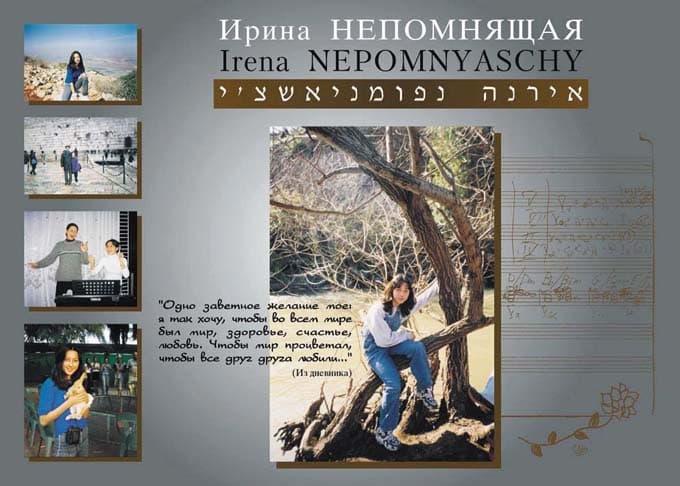

Irena Nepomnyaschy
"We brought here to Israel the best we had — our children..."
A thin, fragile girl who arrived with her parents and older brother from Tashkent in January 1997 adapted to her new surroundings remarkably quickly. Warm, bright, generous, she attracted new friends like a little magnet. She also loved to dance and even reproached her parents for not enrolling her in a dance school. In the last days of her final spring, she played the piano, prepared for exams, and hung out with her friends in the canyon.
Then what happened, happened. A friend came and invited Irina to a disco. Her mother had just returned from work. She said, "Girls, why don't you stay here, walk in the park or canyon? You know what the situation is in the country." "We won't be long," Irina replied. "I've been preparing for exams all week: I'll take a little walk and come back." She didn't even take her phone with her, as if to confirm that she was really just stepping out for a short while. When they went outside, Irina asked her older brother for taxi money. He went to the ATM and withdrew cash. The girls went to "Dolphinarium". They had been there often.
Pavel was the first to learn about what happened — he was walking in Tel Aviv and heard a broadcast on the radio. He called their parents. They found the friend's phone number. "Larisa is in Ichilov," came the reply from the other end. They rushed to Ichilov. They saw one of their daughter's friends: "Where is Irisha?" "I didn't see her, she was standing behind me. I heard an explosion and ran forward," the girl replied. She wasn't on the hospital lists. They went to Abu Kabir. They reported her features. They waited a long time. They were only invited for identification at half past ten in the morning. The mother went inside; the father couldn't get up — his legs wouldn't obey him.
A week before the incident, Raisa, Irina's mother, had a terrible headache and her heart ached. She also had a heavy dream that she didn't tell anyone about. In her dream, her late mother-in-law came to her. Then there appeared either a glade or a cemetery, and someone's voice said: "Here is an empty grave." And the mother-in-law replied to someone invisible: "But this is not for my daughter."
Around the same time, the brother of the deceased girl had a dream that he lost his sister — he was looking for her and couldn't find her, and in the end, he found her for some reason in Jerusalem.
Raisa Nepomnyashchaya, Irina's mother:
— I was always worried about my son. Pavel is studying at university, but he could be mobilised into the army at any moment — that's the situation in the country right now... And Irina was only due to take her first tests at the conscription office in June. Her birthday was on June 17, and she kept asking me: "Mom, how are we going to celebrate it?" My sunshine, my hope, my beauty, my clever daughter, if only I had known!!! I remember her look when she left. I can't forgive myself for not stopping her then... We brought here to Israel the very best we had — our children. Did we really bring them here to die?
Shelly Shraiman. Special Edition of "Vesti"
Here's what Irina's parents wanted to share
In memory of Irina Nepomnyashchaya
Writing about your child can be extensive, but it is doubly hard to write and speak about a child who is not beside you, who is not in this world at all.
The soul is torn with pain and sorrow, and tears do not dry on the eyes. Yet I still want to tell you what our daughter was like, our little Irisha. She was just like millions of other girls. With her own character, with her own strengths and weaknesses. Cheerful and sad, laughing and crying, not particularly standing out from her friends. But she was special to us, to her parents, to her brother, to her relatives.
Of course, for parents, their child is always special, even if just like that. In June 1984, Irisha came into this world to announce herself. "I came, bringing joy, new worries, love into the home".
She was a girl, a daughter (her brother was born four years earlier). And right away, we almost lost her due to the negligence of the maternity hospital staff, who discharged a dehydrated child with a temperature of 40 — the child burning before our eyes, and only thanks to the experience of a doctor from one of the Tashkent hospitals was she saved.
And then, like everyone else: illnesses, sleepless nights by the crib, nursery, kindergarten. A grandmother who adored her granddaughter, worried when she was unwell, and rejoiced at her successes as she grew. This was a child who loved everyone and was loved by everyone she encountered. She quickly made friends, as she was a source of cheerfulness, kindness, and love. She was very upset when she was an unwitting witness to children's quarrels. And Irisha also loved music and dance very much. When we visited friends who had a piano, she would immediately run up to it and poke her fingers on those white and black keys. Therefore, it was her desire to enroll in both the first grade of a general education school and the Arts School in the piano class. Already in the second grade, Irisha suddenly decided that besides piano, she wanted to take ballet classes as well. She managed to do well in both schools despite the heavy workload.
The year 1997 fundamentally changed her life. Moving to Israel. A new country, a new language, new people. Lots of sunshine, an unseen sea. A year of studying in an Israeli school. Israeli children did not accept Irisha very well. Different mentality. She felt like an outsider.
Enrolling in the "Shevach Mofet" school, which is very good but challenging, where a large part of the students are Russian-speaking. This was her environment. Immediately many friends, common interests, and she always said she would never trade her school for another. There she continued to study music professionally in the piano class.
And here her character traits were strengthened. Willingness to help anyone who needed her, and she gratefully accepted help (the language was hard, but her girl friends were nearby).
She rejoiced if someone was doing well and felt sad if someone had problems, deeply experiencing conflicts, as is inevitable. And yet, her love for others, always ready to lend a helping hand, reliability that she would never let you down, drew friends to her, and she was drawn to them. Irisha often participated in concerts for the elderly in nursing homes and always rejoiced at seeing their happy faces; after the concert, she would say that music makes people happy.
Seeing how hard her parents worked (her mother worked 2–3 jobs, her father worked nights at the post office), Irisha tried to help the family; a friend got her a job as a waitress. And this fragile girl, like a reed, carried heavy trays all evening, and at home, after work, she collapsed from exhaustion. But what joy was in her eyes when she opened her own bank account. No need to ask her parents for money for her needs, and she could help them too.
No request went unanswered. She loved to give gifts, which she always chose with taste, and was happy when she saw that the gifts fit. Sensitivity and tenderness always manifested when someone among us fell ill.
She was ready to fulfill any request. She was growing up and blossoming before our eyes — slender, beautiful, tender.
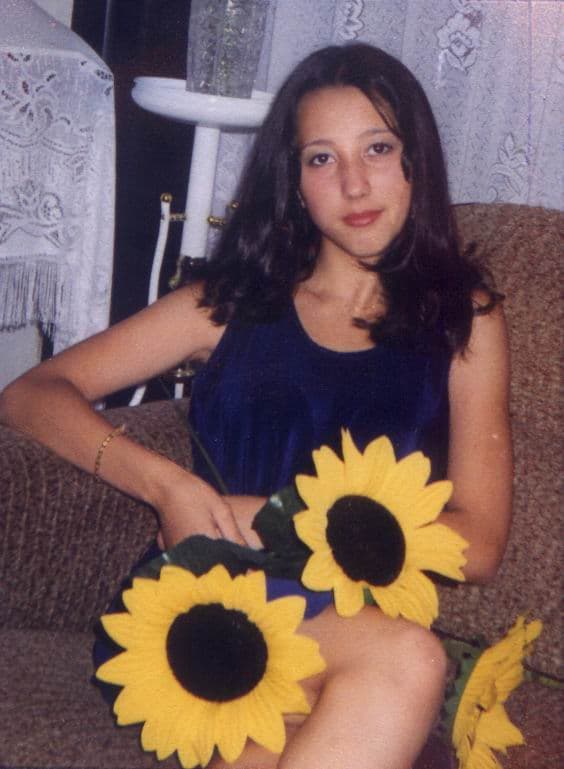
Incredibly determined, beautiful, and smart, our daughter had many friends. Her laughter in our home sounded like a crystal bell. She warmed everyone with her warmth, like a little sun; we called her "our sunshine".
She loved her brother Pavel, was proud of him — he was studying at university, and she wanted to be like him. Irina planned to enter university after finishing school and said she dreamed of being an economist like her mother.
And then came the last day.
Nothing foreshadowed tragedy. Friends came to invite her to a disco — to relax a bit before serious exams.
"Mom, I'll have a little fun today, and tomorrow I'll start studying."
Almost midnight. A terrible message. An explosion at the "Dolphinarium" disco.
Ichilov Hospital. One thought in my mind: "Where is my daughter, what's happened to her?" A sleepless night in Abu Kabir. The terrible news — the mother recognizes her daughter among the dead. No! No! No!
She left us at just seventeen years old, not living just two weeks until her birthday, which she had dreamed of so much.
All dreams and plans for the future collapsed at once. She remained in our hearts as that little girl — tender, affectionate, beloved, who didn't live to see her 17th birthday by just two weeks...
Eternal memory to her.