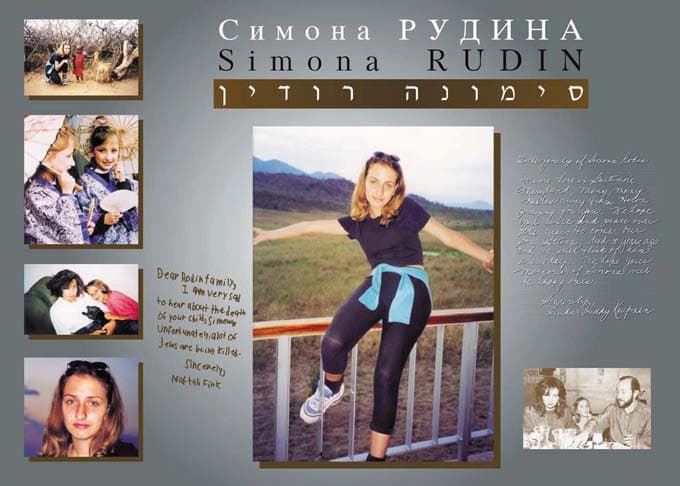

Simona Rudina

“God calls the strongest to Himself…”
Simona would have turned eighteen on August 13. She was the only daughter in a well-off family of well-established Vilnius natives, almost “veterans” (in the country since 1987) — Irina and Mark Rudin. I recorded their story as it was.
— When we repatriated, she was three and a half. A wonderful, warm, kind, good girl. We arrived as a big group, everyone had children her age. Simona adapted very quickly to the country, she was very sociable, immediately felt at home. She loved dancing, loved sports, adored classical music. She was very close with Evgeny Shapovalov and never missed a single one of his concerts.
She treated elderly people with great care — perhaps she felt that she herself would never become old. Four years ago we had a misfortune: her grandmother and grandfather both suffered strokes on the same day and ended up in wheelchairs. For three years she stayed with them, helping to wash and feed them. As a rabbi told us yesterday, God takes the strongest — those who, in their short lives, managed to give away so much warmth that it would have been enough for a hundred more lives.
For many years Simona did not speak Russian. She arrived as a tiny child and wanted to be “like everyone else.” Back then there were almost no “Russians” here. At home we spoke Russian, but she answered us in Hebrew. For her bat mitzvah we gave her a gift — we sent her to England for three weeks, to relax and improve her English. When we met her at the airport, she came out and spoke to us in Russian. Simona learned Russian there, began listening to Russian music, started teaching herself to read and write in Russian, and gained Russian-speaking friends. Lately she preferred to spend time with “Russians.”
Simona loved walking along the Tel Aviv promenade with her friends. She was there almost every Friday. She never drank or smoked. And her friends were the same. She chose them carefully. She very much wanted to have a boyfriend — not just within a group, but on her own — but she didn’t have time…
One of her friends who had been with her at the disco, Rita Abramova, is in very serious condition. That day they had taken an exam and went out to relax a little. When Simona went out, she never turned off her mobile phone and checked in with us every hour or two. We saw everything on television…
She always took Memorial Day very seriously — even too seriously. During the siren she stood and cried. It clearly troubled her deeply. A couple of weeks before her death she told us: “If the Arabs really want to strike our country, they should do it near the Dolphinarium. There are always many people there.” In the last two months they had stopped going out — things in the country were too tense — and that evening they went to the promenade for the first time again…
There is an incredible story behind this photograph. It was taken just a few days ago. Simona suddenly insisted that we hadn’t taken photos together in a long time and that we needed to do it. We went to a bar mitzvah of a colleague’s son, and she made us take a picture.
She clearly felt something. She had always been an affectionate child, but lately she clung to us almost constantly.
We argued with her over something trivial that last Thursday, but I came back and we made up. Now I think: it’s good that at least I managed that.
We hold very right-wing views and demanded immediate retaliation after every terrorist attack. She, on the other hand, would say: “Suicide bombers are suicide bombers, but there are women and children there. They are people too.” We couldn’t argue with her. We repatriated when Israel was testing the “Lavi” aircraft. We were taken to the promenade to watch a test flight. We had been in the country for only a week. A man we didn’t know approached us, shook our hands, spoke to us in English, and for a long time stroked Simona’s head — he liked her very much. It turned out to be the then Prime Minister, Shimon Peres.
Evgeny Shapovalov promised to organize a concert with the best artists in the country — in memory of the children who were killed. The most frightening thing is that in a week or two the excitement will fade, and everything will become just history. The families will remain alone with their grief, and our children will simply become another line in the list of victims of war.
Boris Slutsky. Special issue of “Vesti”