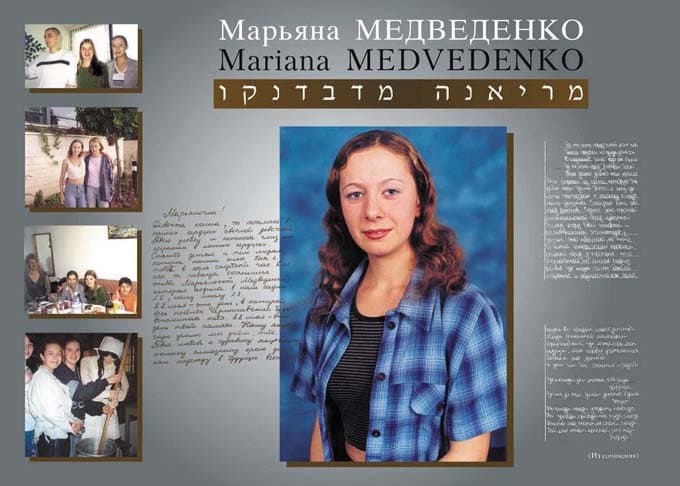

Mariana Medvedenko
“The entire family had great hopes for Mariana”
Jacob Mozganov, the pedagogical director at the Shevah Mofet school and a relative of Mariana, tells us about her:
“The thought that bothered me most on that Saturday morning, when Mariana appeared in the list of deceased was: ‘I brought their family to Israel. Why did I do it?’ In a situation like this, you always keep thinking that if they would’ve stayed in Russia, Mariana would be alive.”
After all, they are only fresh from their birth country — only 2.5 years. My nephew Victor often came to Moscow and we met, and I proudly told him about Shevah Mofet, which was created by Russian teachers in Israel. And I advised — told him to come to Israel for the sake of his children. They were a bit afraid of course — it isn’t easy to start a new life with four children, and their age was over 40 too. But in the end they agreed — for the sake of their children.
In Yakutsk, Victor served as a firefighter in the Taiga, while Mariana’s mother Tatiana was a nurse. They weren’t rich, but could still afford vacations to the south.
In Israel they rented a big apartment and began looking for a job. Life wasn’t easy for them, but it was decent. They bought their children two computers — one just for their oldest daughter Mariana. The other children were a little upset about this, but the parents had great hopes for Mariana — they wanted her to settle down as quickly as possible. Besides, the parents wanted to set a good example for the other children, so they always expressed their pride of Mariana.
She came to our school to the Computerized Graphics class. She loved this new occupation and even bought computer books and could be found practicing for hours.
The family didn’t adapt to the new environment easily though: illegal employment, constant strain and an everlasting lack of money were among their troubles. Victor was depressed, he asked the children: ‘Maybe we should go back to Russia?’, but they replied with ‘We are just like Mariana’ — and Mariana liked everything about Israel. She often said that in Russia she would never have had what she had in Israel. All in all, she was a proactive, beautiful, bold girl, very good at dancing. She also enjoyed trances, which is now one of the most popular types of music among Israeli youth.
She wasn’t great at all subjects. Russian wasn’t her strong point, for example. The teacher always scolded her for not being able to write reports well, which resulted Mariana coming at one time and saying: ‘That’s it, this time I prepared well. I could write a 100-page report if need be!’ But is that very important? Only now I understand that it isn’t. Whenever I met her in the school corridors, she always smiled — so warmly and openly. And even though she was not the greatest student, both teachers and students loved her very much.
Her father tried to convince her not to go to the disco — it was her first time ever, anyway. Mariana protested: ‘I can’t miss it. I promised Anna Kazachkova that I’d come’. She was used to keeping her promises. She wanted to accomplish many things in life — to become the first one in her family to become well established in Israel. And I know she could do everything!”
Victoria Martynova, Special Edition of “Vesti”.